

Starlink sports broadcasting is rapidly changing how major live events are produced in remote locations, and IMG’s coverage of The Women’s Amateur Championship at Nairn Golf Club, Scotland is one of the best recent examples. In partnership with Clarus Networks, LiveU, and Starlink, IMG successfully delivered global live coverage of one of amateur golf’s most prestigious tournaments without relying on traditional broadcast infrastructure such as fibre, outside broadcast trucks, or RF relay towers.
Set on Scotland’s northeast coast, Nairn Golf Club is known for its scenic beauty but also for the significant technical challenges it presents to live production teams. The venue’s large course footprint, changing terrain, and requirement for mobile camera positions make conventional broadcasting expensive and operationally complex. This is where Starlink sports broadcasting proved transformative.
By combining Starlink’s low-latency satellite connectivity with IP-based remote production workflows, the production team achieved 100% remote course coverage, reduced deployment costs by 70%, and cut carbon emissions by 90% compared with traditional OB setups.
This case marks a major milestone in the future of sports media technology.
How Starlink Sports Broadcasting Solved the Remote Venue Challenge
The success of Starlink sports broadcasting at Nairn depended on carefully engineered mobile connectivity.
According to the official case study, the team deployed:
- 8 Starlink Enterprise terminals
- 7 active live-feed terminals
- 1 hot-swap backup terminal
These terminals were strategically distributed across the golf course to support uninterrupted multi-camera operations.
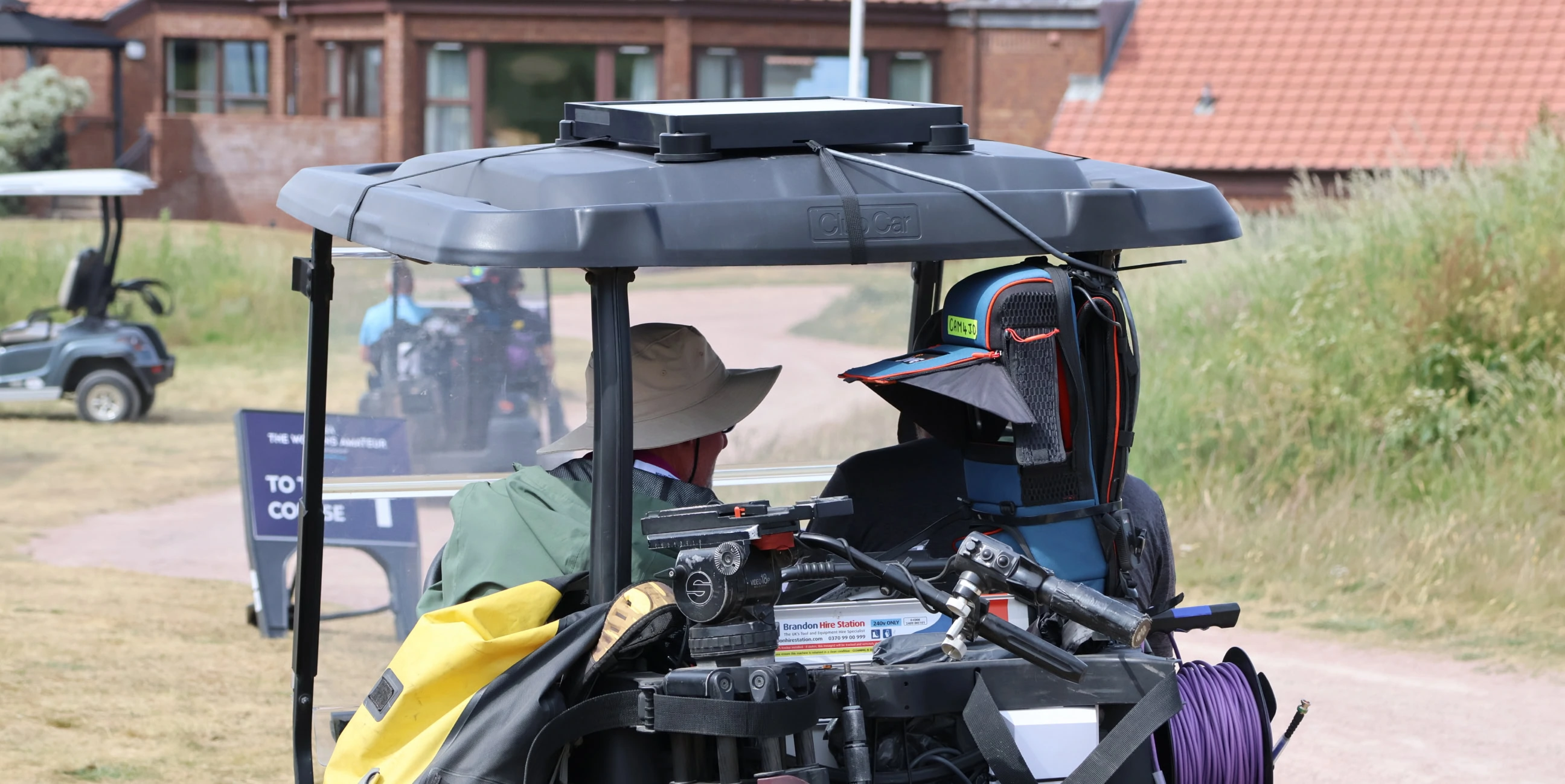
A particularly innovative aspect of the deployment was the use of custom buggy roof mounts designed by Clarus Networks. These mounts allowed mobile camera units to move freely across the course while maintaining optimized line-of-sight signal positioning.
This meant camera teams could follow play across long fairways and greens without signal loss.
For golf broadcasting, where shots may span hundreds of meters, this mobility is essential.
Why Starlink Sports Broadcasting Is Ideal for Live Sports
The strength of Starlink sports broadcasting lies in its flexibility.
Traditional sports broadcasting often depends on:
- fibre trenching
- heavy OB trucks
- RF towers
- extensive cabling
- large on-site crews
These systems are expensive and difficult to deploy at remote venues.
With Starlink, all of that changes.
The Nairn deployment proved that live professional broadcasting can now be delivered using a fully portable satellite workflow.
This is particularly valuable for:
- golf tournaments
- outdoor motorsports
- cycling races
- sailing events
- remote stadium productions
Because satellite connectivity removes dependence on local infrastructure, broadcasters can now operate from virtually any location.

Starlink Sports Broadcasting and Remote Production Workflow
One of the most advanced elements of this deployment was the remote production architecture.
While cameras operated on the golf course, most production functions were managed remotely from IMG’s Stockley Park production facility in London.
This included:
- graphics
- commentary
- live switching
- VT playback
- final program output
The video transmission workflow used LiveU LU800 LIQ encoders, which bonded Starlink satellite bandwidth with terrestrial mobile signals for maximum redundancy.
This approach ensured:
- stable bitrate performance
- ultra-low latency
- synchronized feeds
- transmission resilience
The final output was distributed to 20+ global broadcasters and YouTube, enabling international live viewership at broadcast-grade quality.
This demonstrates how Starlink sports broadcasting can scale for global sports audiences.
Cost and Sustainability Benefits
A major reason Starlink sports broadcasting is gaining industry attention is cost efficiency.
Compared with traditional outside broadcast solutions, the deployment achieved:
- 70% lower production costs
- 90% lower carbon footprint
These savings came from eliminating:
- diesel-powered OB trucks
- generators
- heavy transport logistics
- fibre installation
For sports media companies facing rising production budgets, this is highly significant.
The environmental impact is equally important.
As sports organizations increasingly adopt ESG and sustainability goals, Starlink-powered workflows provide a strong operational advantage.

Internal Link: Advanced Starlink Connectivity Accessories
For professional-grade Starlink deployment accessories and satellite networking solutions, visit our independent store:
We offer:
- waterproof Ethernet adapters
- DC power systems
- mounting kits
- mobile installation solutions
These products are ideal for field broadcasting and remote connectivity setups.
External Link: Official Starlink Case Study
For the official broadcasting case study, visit Starlink Business:
https://starlink.com/business/case-studies/img
The Future of Starlink Sports Broadcasting
The success of this event creates a repeatable blueprint for future productions.
This model can be expanded into:
- PGA and LPGA tournaments
- tennis opens
- marathons
- motorsports
- outdoor esports activations
The combination of Starlink Enterprise terminals + IP remote production may soon become a standard solution for live event media.
As more broadcasters prioritize flexibility, speed, and sustainability, Starlink sports broadcasting is positioned to become a core technology in the sports production industry.

Conclusion
IMG’s deployment at The Women’s Amateur Championship proves that Starlink sports broadcasting is no longer experimental—it is production-ready at a world-class level.
By delivering reliable live coverage from one of golf’s most infrastructure-challenging venues, Starlink has demonstrated how satellite-powered workflows are reshaping the economics and technical possibilities of sports broadcasting.
This is likely just the beginning.


Leave a comment